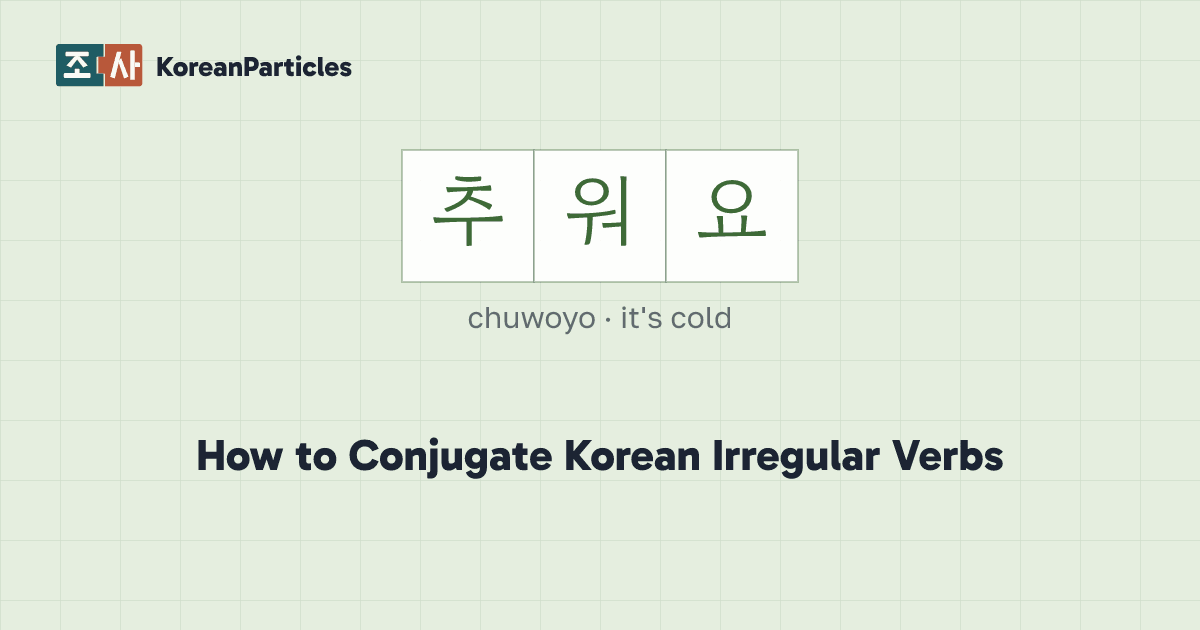
How to Conjugate Korean Irregular Verbs (With a Chart)
Francisco Pieklo
Editor
Irregular verbs are the Korean verbs that change their stem, or sometimes their ending, when you conjugate them, so the normal rules give you a word that doesn’t exist. For example, 듣다 (deutda, “to listen”) should become 듣어요 if you follow the usual steps, but Koreans actually say 들어요 (deureoyo, “I listen”). You can’t avoid them for long, either, because some of the first words you learn are irregular: 춥다 (chupda, “to be cold”), 모르다 (moreuda, “to not know”), 어렵다 (eoryeopda, “to be difficult”) and 고맙다 (gomapda, “to be thankful”) all are.
In this post I’ll show you exactly when an irregular verb changes and when it stays the same, because once you know that, they’re much easier to handle. After that, I’ll go through each group with a chart of the forms you’ll use most. I’ll use the same seven groups as the site’s irregular verbs page, named after the letter that changes: ㅂ (b), ㄷ (d), ㅅ (s), ㅎ (h), 르 (reu), 으 (eu) and 러 (reo). Then, at the end, I’ll show you how to tell whether a verb is irregular before you get it wrong. If you haven’t read it yet, my post on Korean verb conjugation rules covers the regular verbs, and everything here builds on it.
Irregular verbs only change before some endings
The good news is that an irregular verb doesn’t change every time. What decides it is how the ending starts, and Korean endings come in three kinds:
- Endings that start with a consonant, like 고 (go, “and”), 지만 (jiman, “but”) or the formal 습니다 (seumnida). With these, the stem almost always stays exactly as it is in the dictionary.
- Endings that start with 아 or 어, like 아요/어요 (ayo/eoyo) and 았어요/었어요 (asseoyo/eosseoyo). Every irregular group changes here.
- Endings that start with 으, like 으면 (eumyeon, “if”) and 을 거예요 (eul geoyeyo, “will”). Only some groups change here, as you’ll see below.
Here’s 듣다 with one ending of each kind:
Ending starts with a consonant
→듣고
deutgo, “listen and”
Ending starts with 아/어
→들어요
deureoyo, “I listen”
Ending starts with 으
→들으면
deureumyeon, “if I listen”
So 듣고, 듣지만 (deutjiman) and 듣습니다 (deutseumnida) are all regular, and only the last two cards show the change. The main exception you might run into is 네요 (neyo) with ㅎ adjectives, where both 빨갛네요 (ppalganneyo) and 빨가네요 (ppalganeyo, “it’s red!”) are correct. But the groups don’t all behave the same way with 으. For 르 verbs, for example, the 으 ending doesn’t cause a change at all, because 모르다 + 으면 is just 모르면 (moreumyeon, “if I don’t know”). That’s because the 으 at the start of these endings only appears after a stem that ends in a consonant. The 르, 으 and 러 stems end in a vowel, so the 으 never appears, just like with a regular verb such as 가다 (gada, “to go”) → 가면 (gamyeon, “if I go”), and there’s nothing to trigger a change. In the table below, 아/어 (a/eo) means endings like 아요 (ayo) and 았어요 (asseoyo), and 으 (eu) means endings like 으면 (eumyeon) and 을 거예요 (eul geoyeyo):
| Group | Changes before 아/어 a/eo | Changes before 으 eu |
|---|---|---|
| ㅂ b | yes | yes |
| ㄷ d | yes | yes |
| ㅅ s | yes | yes |
| ㅎ h | yes | yes |
| 르 reu | yes | no |
| 으 eu | yes | no |
| 러 reo | yes | no |
That’s why the present and past tenses are the forms to practice first: every irregular group changes there.
A chart of the common forms
Here are the forms you’ll use most for one or two common verbs from each group, starting with the present and past, where every group changes:
| Verb | Present | Past |
|---|---|---|
| 춥다 chupda · “to be cold” | 추워요 chuwoyo | 추웠어요 chuwosseoyo |
| 돕다 dopda · “to help” | 도와요 dowayo | 도왔어요 dowasseoyo |
| 듣다 deutda · “to listen” | 들어요 deureoyo | 들었어요 deureosseoyo |
| 짓다 jitda · “to build” | 지어요 jieoyo | 지었어요 jieosseoyo |
| 빨갛다 ppalgata · “to be red” | 빨개요 ppalgaeyo | 빨갰어요 ppalgaesseoyo |
| 모르다 moreuda · “to not know” | 몰라요 mollayo | 몰랐어요 mollasseoyo |
| 쓰다 sseuda · “to write” | 써요 sseoyo | 썼어요 sseosseoyo |
| 이르다 ireuda · “to arrive” | 이르러요 ireureoyo | 이르렀어요 ireureosseoyo |
Next come 으면 (eumyeon, “if”) and the future, 을 거예요 (eul geoyeyo). These are where the 르, 으 and 러 verbs stay regular, so 모르면 and 이르면 look just like the dictionary form without 다:
| Verb | If | Future |
|---|---|---|
| 춥다 chupda | 추우면 chuumyeon | 추울 거예요 chuul geoyeyo |
| 돕다 dopda | 도우면 doumyeon | 도울 거예요 doul geoyeyo |
| 듣다 deutda | 들으면 deureumyeon | 들을 거예요 deureul geoyeyo |
| 짓다 jitda | 지으면 jieumyeon | 지을 거예요 jieul geoyeyo |
| 빨갛다 ppalgata | 빨가면 ppalgamyeon | 빨갈 거예요 ppalgal geoyeyo |
| 모르다 moreuda | 모르면 moreumyeon | 모를 거예요 moreul geoyeyo |
| 쓰다 sseuda | 쓰면 sseumyeon | 쓸 거예요 sseul geoyeyo |
| 이르다 ireuda | 이르면 ireumyeon | 이를 거예요 ireul geoyeyo |
I’ve left out 고, because as you saw above, it never changes the stem: 춥고 (chupgo), 돕고 (dopgo), 듣고 (deutgo) and so on.
What happens in each group
ㅂ (b): before 아/어 or 으, the ㅂ at the bottom of the stem turns into 우 (u). Before 어, the 우 and 어 then merge into 워 (wo), the same way they do in a regular verb like 배우다 (baeuda, “to learn”) → 배워요 (baewoyo), so 춥 + 어요 becomes 추워요. Before 으, the ending’s 으 drops, so 춥 + 으면 becomes 추우면 (chuumyeon). 돕다 and 곱다 (gopda, “to be pretty”) are different only before 아: there the ㅂ becomes 오 (o), and 오 + 아 merge into 와 (wa), which is why you get 도와요 and 고와요 (gowayo), not 도워요. Before 으 they work like every other ㅂ verb, so it’s 도우면 (doumyeon, “if I help”) and 고우면 (goumyeon, “if it’s pretty”).
ㅂ becomes 우
→추워요
chuwoyo, “it’s cold”
ㅂ becomes 오 (돕다 and 곱다, before 아 only)
→도와요
dowayo, “I help”
ㄷ (d): the ㄷ turns into ㄹ (l), and nothing else changes. So 걷다 (geotda, “to walk”) becomes 걸어요 (georeoyo), and 묻다 (mutda, “to ask”) becomes 물어요 (mureoyo). Be careful with these two, though, because each one shares its spelling with a regular verb. I’ll come back to them below.
ㅅ (s): before 아/어 or 으, the ㅅ disappears, but in standard spelling the two vowels that meet don’t merge afterwards, which is easy to get wrong. 짓다 becomes 지어요, not 져요, and 낫다 (natda, “to get better”) becomes 나아요 (naayo), not 나요.
ㅎ (h): before 아/어, the ㅎ disappears and the ending’s 아/어 changes too, and the vowel you end up with depends on the stem. A stem with ㅏ gives ㅐ (ae), so 빨갛다 becomes 빨개요. A stem with ㅓ gives ㅔ (e), so 누렇다 (nureota, “to be yellowish”) becomes 누레요 (nureyo), and a stem with ㅑ gives ㅒ (yae), so 하얗다 (hayata, “to be white”) becomes 하얘요 (hayaeyo). The common words 그렇다 (geureota, “to be so”), 이렇다 (ireota, “to be like this”), 저렇다 (jeoreota, “to be like that”) and 어떻다 (eotteota, “to be how”) are the exception: they have ㅓ but take ㅐ, so you say 그래요 (geuraeyo) and 어때요 (eottaeyo, “how is it?”). Before 으, the ㅎ disappears and the 으 drops as well, which is why you get 빨가면 (ppalgamyeon, “if it’s red”) and say 빨간 (ppalgan, “red”) in 빨간 사과 (ppalgan sagwa, “a red apple”).
르 (reu): before 아/어, the 으 drops, and an extra ㄹ goes onto the syllable before it. So 모르 + 아요 becomes 몰라요, and 부르다 (bureuda, “to call, to sing”) becomes 불러요 (bulleoyo).
르 doubles its ㄹ
→몰라요
mollayo, “I don’t know”
으 (eu): the ㅡ drops, and you pick 아 or 어 by looking at the syllable before it, so 바쁘다 (bappeuda, “to be busy”) becomes 바빠요 (bappayo). I covered this one in the conjugation post, because it happens to almost every verb whose stem ends in ㅡ. Strictly speaking, Korean grammar counts this as a regular change, since dropping one of two vowels that meet is something Korean does all the time, as in 가 + 아요 → 가요 (gayo). Korea’s official spelling rules still list it with the irregular verbs out of tradition, though, and so do many learner books, so I’ve kept it as one of the seven groups.
러 (reo): this group is tiny, and it’s the only one of the seven where the ending changes instead of the stem. Instead of 어, you add 러, so 이르다 (to arrive) becomes 이르러요. 이르다 is a formal word, so you’ll mostly see it in writing, in phrases like 정상에 이르렀어요 (jeongsange ireureosseoyo, “we reached the top”). The other member you’re likely to meet is 푸르다 (pureuda, “to be blue or green”), which becomes 푸르러요 (pureureoyo).
The spelling rules also list a few patterns I’ve left out of the seven. One is 하다 (hada, “to do”), which becomes 해요 (haeyo). Another is a stem that ends in ㄹ losing its ㄹ before some endings, like 살다 (salda, “to live”) → 삽니다 (samnida). I covered both in the conjugation post, and grammar books count the ㄹ change as regular, the same as the 으 one. The last is 푸다 (puda, “to scoop”), which becomes 퍼요 (peoyo). The rules put it in the same item as the 으 verbs, but it drops ㅜ instead of ㅡ, and it’s the only verb they give for that.
이르다 shows why spelling isn’t enough
이르다 is a good example of how tricky this gets, because the dictionary has three different words spelled 이르다, and they don’t conjugate the same way. When it means “to arrive,” it’s a 러 verb, but when it means “to tell” (or “to tell on someone”) or “to be early,” it’s a 르 verb:
| Meaning | Present | Example |
|---|---|---|
| to arrive | 이르러요 ireureoyo | 목적지에 이르렀어요 mokjeokjie ireureosseoyo · “we reached the destination” |
| to tell on someone | 일러요 illeoyo | 선생님한테 일렀어요 seonsaengnimhante illeosseoyo · “I told on them to the teacher” |
| to be early | 일러요 illeoyo | 아직 일러요 ajik illeoyo · “it’s still early” |
It isn’t the only one. The spelling rules mark 걷다, 묻다 and 굽다 as irregular in one meaning only, because each one shares its spelling with one or more regular words:
| Word and meaning | Present | Type |
|---|---|---|
| 걷다 geotda, to walk | 걸어요 georeoyo | ㄷ irregular |
| 걷다 geotda, to roll up | 걷어요 geodeoyo | regular |
| 묻다 mutda, to ask | 물어요 mureoyo | ㄷ irregular |
| 묻다 mutda, to bury | 묻어요 mudeoyo | regular |
| 굽다 gupda, to bake, to grill | 구워요 guwoyo | ㅂ irregular |
| 굽다 gupda, to bend | 굽어요 gubeoyo | regular |
The same goes for 곱다 from the ㅂ section. When it means “to be pretty,” it’s 고와요 (gowayo), but when it means “to be numb with cold,” as in 손이 곱다 (soni gopda, “my hands are numb”), it’s regular and becomes 곱아요 (gobayo). So when a verb has more than one meaning, check which one you’re using before you conjugate it.
How to tell if a verb is irregular
You can’t always tell from the spelling, because some verbs that look the same conjugate differently. For example, 입다 (ipda, “to wear”) is regular and becomes 입어요 (ibeoyo), while 춥다 is irregular and becomes 추워요. The same goes for 닫다 (datda, “to close”) and 듣다, and for 웃다 (utda, “to laugh”) and 짓다:
| Looks irregular, but isn’t | Irregular |
|---|---|
| 입다 → 입어요 ibeoyo · “I wear” | 춥다 → 추워요 chuwoyo · “it’s cold” |
| 닫다 → 닫아요 dadayo · “I close” | 듣다 → 들어요 deureoyo · “I listen” |
| 웃다 → 웃어요 useoyo · “I laugh” | 짓다 → 지어요 jieoyo · “I build” |
| 좋다 → 좋아요 joayo · “it’s good” | 빨갛다 → 빨개요 ppalgaeyo · “it’s red” |
There are a few patterns that help, though. Almost every adjective that ends in a single ㅂ is irregular, like 덥다 (deopda, “to be hot”), 쉽다 (swipda, “to be easy”) and 맵다 (maepda, “to be spicy”), and 좁다 (jopda, “to be narrow”) is a common exception, since it becomes 좁아요 (jobayo). With ㅎ it’s even simpler, because every adjective that ends in a single ㅎ is irregular except 좋다 (jota, “to be good”). Adjectives that end in two consonants, like 많다 (manta, “to be many”) or 괜찮다 (gwaenchanta, “to be okay”), are regular, so they become 많아요 (manayo) and 괜찮아요 (gwaenchanayo). And almost every verb that ends in 르 is a 르 verb, apart from the few 러 verbs like 이르다 (to arrive). The other common exceptions are 따르다 (ttareuda, “to follow”), which becomes 따라요 (ttarayo), 들르다 (deulleuda, “to drop by”), which becomes 들러요 (deulleoyo), and 치르다 (chireuda, “to take an exam, to pay”), which becomes 치러요 (chireoyo).
When you’re not sure, look the verb up in the Basic Korean Dictionary from the National Institute of Korean Language. In the Korean version of each entry there’s a line marked 활용 (hwaryong, “conjugation”) that lists a few conjugated forms. For 듣다, for example, it shows 들어 (deureo) and 들으니 (deureuni), so you can see straight away that it’s irregular. I checked the forms in this post against the institute’s dictionaries and the official spelling rules.
To sum up, an irregular verb almost never changes before an ending that starts with a consonant. Every group changes before 아/어, but only the ㅂ, ㄷ, ㅅ and ㅎ groups change before 으. So if you learn the present and past forms of the common ones first, you’ll get most of them right. I’ve put the full list of common irregular verbs, grouped by type, on the Korean irregular verbs page.
Which irregular verb do you still get wrong? Find its group in the irregular verbs list and practice its present and past forms first.
Sources
- Basic Korean Dictionary (National Institute of Korean Language)
- Korean Spelling Rules, Article 18 (한글 맞춤법 (hangeul matchumbeop), National Institute of Korean Language)
- 2015 standard language additions, including 노랗네 next to 노라네 (National Institute of Korean Language)
- Conjugating verbs and adjectives, parts 1 and 2 (용언의 활용 (yongeonui hwaryong), 국립국어원 온라인 소식지 (gungnipgugeowon ollain sosikji), the institute’s online newsletter, 2020)