The Korean Counter Workbook · PDF Count anything in Korean without stopping to think
Every time you count in Korean you make two choices: the counter, and which of the two number systems it takes. This workbook drills both across the 20 counters you’ll use every day, with 44 exercises and every answer included.
Instant PDF download Print it or use a tabletOne payment
Free with it: a printable cheat sheet and a 91-card Anki deck.
30-day money-back guarantee. If it doesn’t help you, I’ll refund you in full.
- chapters
- 9chapters
- counters
- 20counters
- exercises
- 44exercises
- pages
- 76pages
Try it
Three questions from the book
Pick the Korean you’d say. Each question tests a different rule from the book: a number that changes shape, a time that mixes both systems, and a food counter that doesn’t follow the others.
Question 1
I need twenty pencils.
연필 ___ 필요해요.
yeonpil ___ piryohaeyo
Question 2
It’s 2:30 in the afternoon.
___이에요.
___ieyo
Question 3
Three portions of pork belly, please.
삼겹살 ___ 주세요.
samgyeopsal ___ juseyo
Who it’s for
It’s for you if…
You don’t need to be far along. If you can sound out hangul, the book takes you from what a counter is to mixing them all in one sentence.
- You know your numbers, but you freeze when a counter comes after one.
- You mix up 세 and 삼, or 두 시 and 이 시, and want to stop guessing.
- You want to order food, give the time and say a date without stopping mid-sentence.
- You learn best by doing exercises and checking your own answers.
What’s inside
What the nine chapters cover
The first two chapters set up the rules every counter follows. Each chapter after that takes one kind of thing you count, and the last one mixes everything together, so by the end you’re switching between counters and number systems the way you would in a real conversation.
takes Native numbers (한, 두, 세 · han, du, se) takes Sino numbers (일, 이, 삼 · il, i, sam)
- 01
What a counter is
Where the counter goes in a sentence, and the five numbers that change shape in front of one: 하나 → 한 (han), 둘 → 두 (du), 셋 → 세 (se), 넷 → 네 (ne), 스물 → 스무 (seumu).
- 02
The two number systems
Native numbers like 하나 (hana) and Sino-Korean ones like 일 (il), side by side: when to use which, and how to read prices in 만 (man, ten thousand).
- 03
Objects
- 개gaethings
The counter you can use for almost any object, and the one rule about what it never counts.
- 04
People
- 명myeongpeople
- 분bunpeople, polite
- 인inset phrases
- 사람saramcasual
Four ways to count people, and the politeness that decides between them.
- 05
Drinks
- 잔janglasses, cups
- 병byeongbottles
- 캔kaencans
Ordering for yourself and for a table, at a café or over soju.
- 06
Food
- 그릇geureutbowls
- 접시jeopsiplates
- 인분inbunportions
- 끼kkimeals
- 조각jogakslices
Everything you need to order a full table, including the food counter that breaks the pattern.
- 07
Telling the time
- 시sio’clock
- 분bunminutes
- 초choseconds
- 시간siganhours long
Why 2:30 uses both number systems, and the difference between “at two” and “for two hours”.
- 08
Dates
- 일ildays
- 월wolmonths
- 년nyeonyears
Writing any date the Korean way, and the two months that are spelled differently.
- 09
Putting it all together
Fifteen exercises built on real situations: a restaurant order, a café run for five, a market, a birthday party, a text to a friend, and a diary entry that pulls it all together.
At the back there’s a reference with every counter in the book and both number systems from 1 to 10,000, on two pages you can print and keep next to you.
Look inside
Real pages from the book
Tap any page to read it full size. Every number in the book is colored by its system, clay for Native and teal for Sino, so after a few chapters you know which one a counter takes before you’ve thought about it.
Free with your purchase
Two extras, included in the price
The workbook teaches the counters. These two help you keep them: one to look at, one to practice with every day. Both download together with the book.
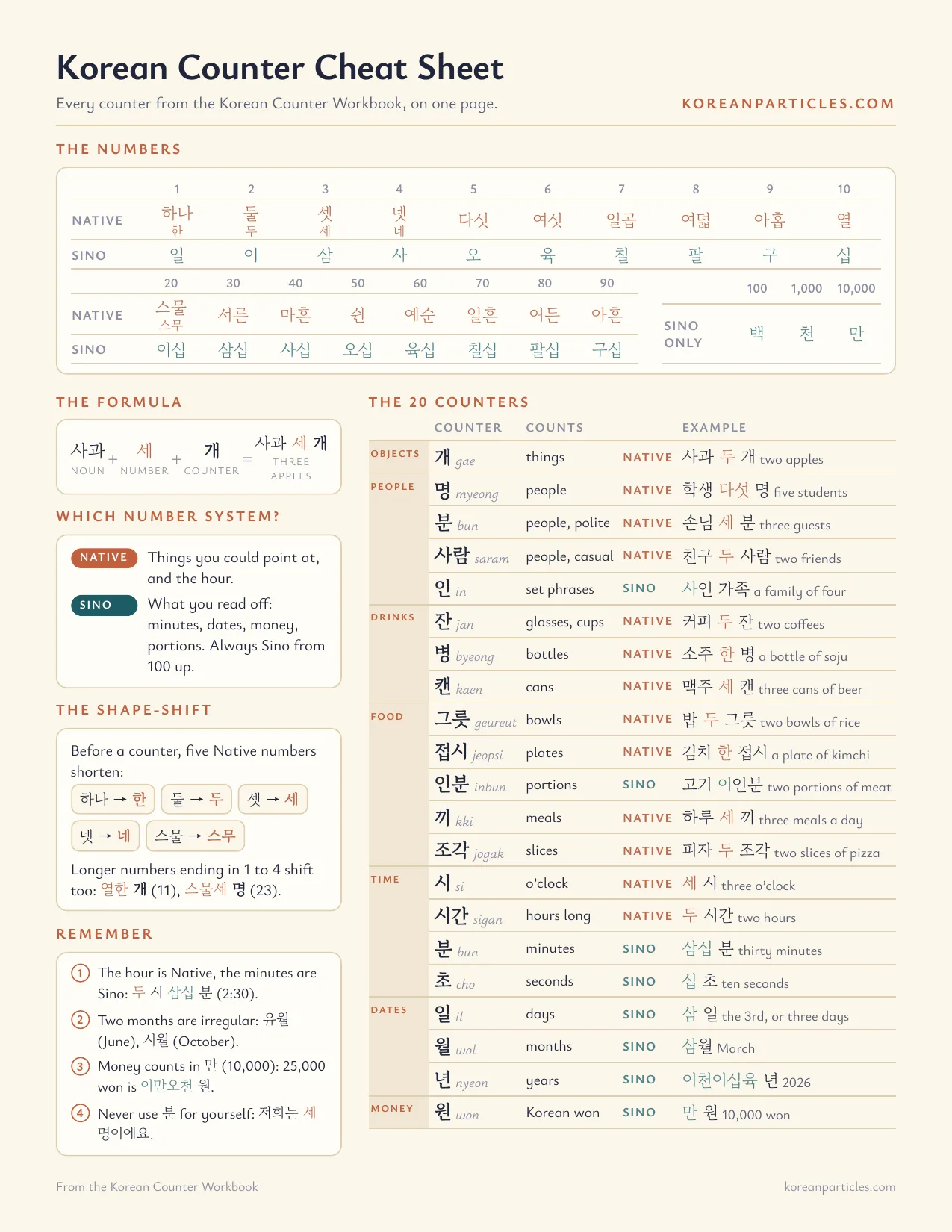
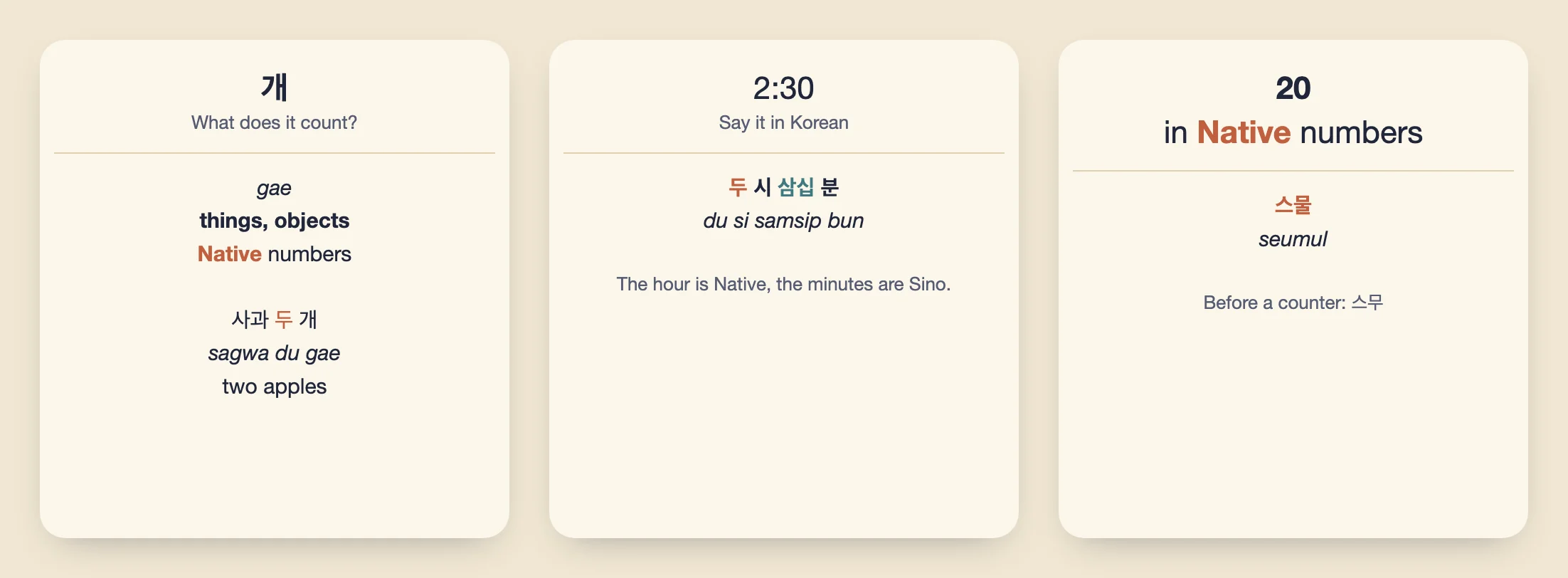
The workbook, the cheat sheet and the Anki deck, all for $12.
How each chapter works
Learn the rule, use it, check it
Every chapter follows the same order, so you always know where you are. You learn the rule first, then you see it in real sentences, and then you practice it with exercises that get harder as you go. When you’re done, the answer key tells you exactly what you got wrong, and a short recap gives you the rules to come back to.
- 1The ruleBuilt up piece by piece, with the reason behind it.
- 2Real sentencesWith romanization and English under every one.
- 3ExercisesFill in, correct, translate, and order for a whole table.
- 4Answer keyEvery answer, at the end of the chapter.
- 5In ShortThe chapter’s rules on one card, for a quick review.
The site and the book
Why buy it when the counters page is free?
If you’ve used the counters page, you already know where to look a counter up. Knowing that 잔 (jan) counts cups doesn’t mean it comes out right when you’re ordering for four, though, and that only comes from practice, with answers to check yourself against. That’s what the workbook gives you.
On koreanparticles.com, free
- Every Korean counter, grouped by what it counts
- Examples for each one
- A builder that puts any number in front of any counter
In the workbook
- 44 exercises, with every answer
- A printable cheat sheet and an Anki deck, free with it
- Real situations: ordering, telling the time, writing dates, planning a trip
- A step-by-step path from your first counter to mixing them all
- Pages you can print, write on and keep by your desk
Who made it
Hi, I’m Francisco
I write koreanparticles.com, the free site that explains Korean particles one at a time. This workbook does the same for counters: one clear rule at a time, real sentences, and enough practice to make it stick. If anything in it isn’t clear, write to me through the contact page and I’ll answer you myself.
Questions
Before you buy
What level do I need to be?
You need to be able to read hangul, and slowly is fine. The book starts from what a counter is, so it works from your first months of Korean. If you already count things but still hesitate over 두 시 (du si, two o’clock) or 삼인분 (sam-inbun, three portions), the later chapters and the combined exercises are where you’ll get the most out of it.
Is there romanization?
Yes. Example sentences have the romanization and the English under the Korean, and new counters come with their romanization in brackets. The exercises are in hangul, because that’s what you’re practising.
What format is it?
A 76-page PDF. It’s set up for US Letter and prints fine on A4. You can also write straight on it in a tablet app like GoodNotes or Notability.
Are the answers included?
Every exercise has its answer in the key at the end of its chapter, so you can check yourself as you go without a teacher.
Isn’t this already on the site?
The site’s counters page lists every counter with examples, and it’s free. The exercises, the answer keys, the chapter recaps and the real-life situations are only in the book. The site is where you look a counter up; the book is where you practice until you don’t need to.
What about counters like 마리, 권 or 장?
The book covers the twenty you’ll use every day and shows you how every counter works, so 마리 (mari, animals), 권 (gwon, books) and 장 (jang, flat things) follow rules you already know. You can look any of them up on the counters page.
What if it isn’t for me?
Then you get your money back. If the workbook doesn’t help you within 30 days of buying it, write to me through the contact page and I’ll refund you in full. You don’t need to give a reason.
How do I get it?
Right after you pay you get the download, with the cheat sheet and the Anki deck alongside the workbook, and the link is emailed to you as well, so you can download them again on another device.
How do I use the Anki deck?
Anki is a flashcard app that shows you each card just before you’d forget it. It’s free on computers, Android and the web; on iPhone the app is AnkiMobile, which is paid. Open the file in Anki and you get three decks: the 20 counters, 31 everyday phrases to say in Korean, and the numbers in both systems.
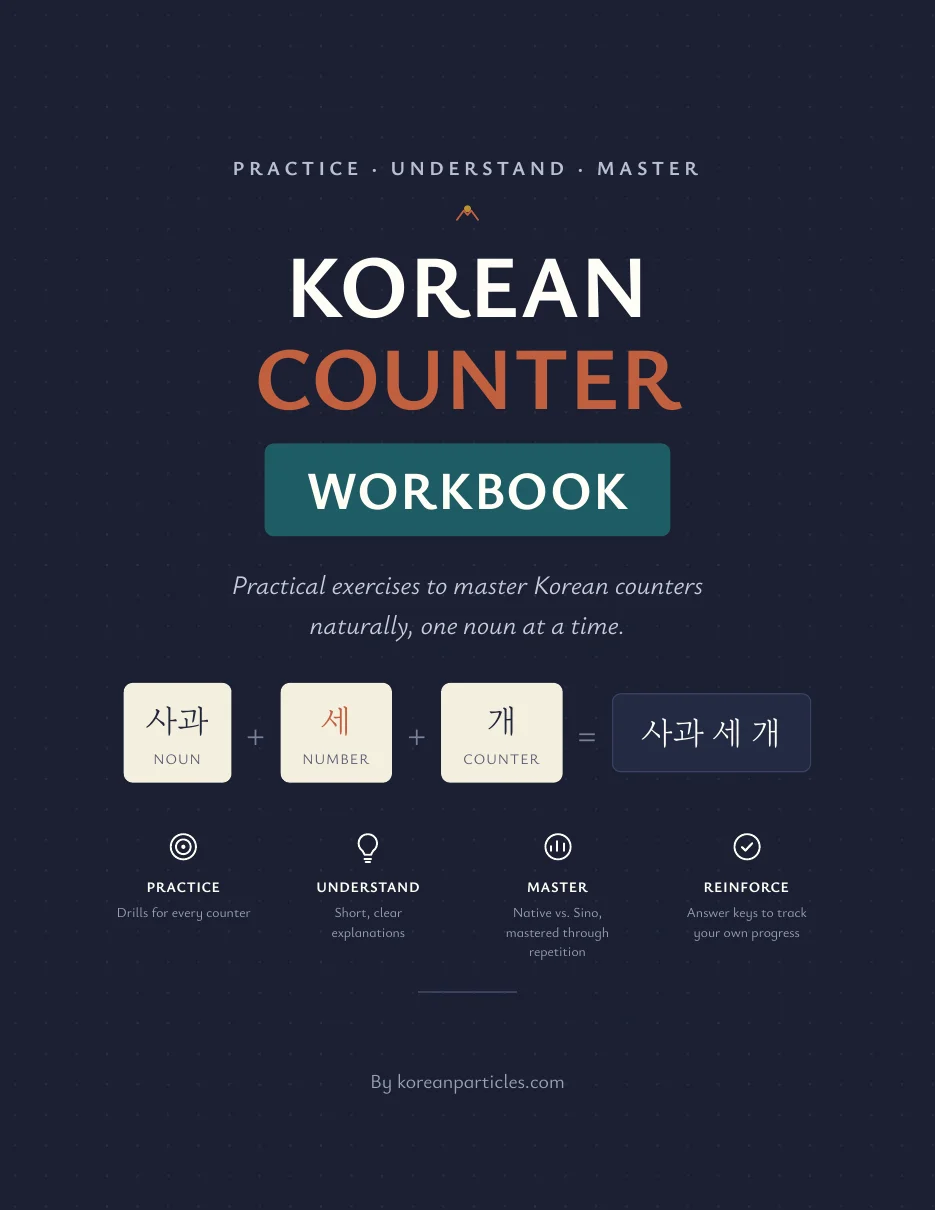
하나, 둘, 셋 (hana, dul, set · one, two, three)
Get the Korean Counter Workbook
Everything you get for $12
- The 76-page workbook: 9 chapters, 20 counters, 44 exercises with every answer
- The Korean Counter Cheat Sheet, free
- The Anki deck with 91 cards, free
- A 30-day money-back guarantee
Instant PDF download Print it or use a tabletOne payment