Korean Speech Levels and Honorifics: 요, 습니다, 세요 and 시
Francisco Pieklo
Editor
Korean changes the end of almost every sentence depending on who you're talking to. For example, "I'm going" can be 가 (ga), 가요 (gayo) or 갑니다 (gamnida), and all three mean exactly the same thing. The only difference is how polite you're being, but Koreans notice it right away, so the wrong one can make you sound rude or oddly stiff. These are called speech levels. On top of them, Korean has honorifics, which show respect for the person you're talking about, and that's where 세요 (seyo) and 시 (si) come in.
In this post I'll go through the three speech levels you'll actually hear, how to build each one and when to use it. After that I'll explain honorifics, because that's the part that confuses most learners, and at the end there's a quick guide to which form to use with whom.
The three speech levels you'll hear every day
Korean grammar books list up to seven speech levels, but most of them are old-fashioned or only turn up in writing. In everyday life you'll hear three: casual, polite and formal. Here are two verbs in each:
| Level | 가다 gada · to go | 먹다 meokda · to eat |
|---|---|---|
| Casual | 가 ga | 먹어 meogeo |
| Polite | 가요 gayo | 먹어요 meogeoyo |
| Formal | 갑니다 gamnida | 먹습니다 meokseumnida |
The meaning doesn't change from row to row, only the relationship between you and the listener. So the question every time you speak is "who am I talking to?", and the sections below answer it level by level.
Polite: the 요 form you'll use most
If you only learn one level, make it this one. The polite 요 (yo) form is what you use with strangers, shop staff, coworkers and anyone you've just met, and it's respectful without sounding stiff. You build it from the verb stem with 아요 (ayo) or 어요 (eoyo): stems whose last vowel is ㅏ or ㅗ take 아요, the rest take 어요, and 하다 (hada) verbs end in 해요 (haeyo). For nouns, you use 이에요 (ieyo) after a consonant and 예요 (yeyo) after a vowel:
Last vowel ㅏ or ㅗ
→앉아요
anjayo, "I sit"
Any other vowel
→먹어요
meogeoyo, "I eat"
Noun after a consonant
→학생이에요
haksaengieyo, "I'm a student"
Noun after a vowel
→의사예요
uisayeyo, "I'm a doctor"
The same form works for statements, questions and suggestions, and only your tone changes, so 가요 (gayo) can mean "I'm going", "are you going?" or "let's go". You can even add 요 to a single word to keep a short answer polite, like 커피요 (keopiyo, "coffee, please"). The 요 lesson has more of those, and my post on Korean verb conjugation rules goes through the 아/어 choice step by step.
Formal: 습니다 for announcements, the news and work
The formal 습니다 (seumnida) form is what you hear on the subway, on the news and in presentations, and it's also how staff often speak to customers in banks, hotels and department stores. It's 습니다 after a consonant and ㅂ니다 (mnida) after a vowel, and questions end in 습니까 (seumnikka) or ㅂ니까 (mnikka):
After a consonant
→먹습니다
meokseumnida, "I eat"
After a vowel
→갑니다
gamnida, "I go"
Question
→갑니까?
gamnikka, "do you go?"
You already know a few of these, like 감사합니다 (gamsahamnida, "thank you") and 입니다 (imnida, "it is"). But formal doesn't mean more respectful in a personal way, it means more official. In most everyday conversations, even with older people, polite 요 is the normal choice, and using 습니다 for everything isn't rude, though it can make you sound like you're giving a speech. Also, 요 doesn't go after 습니다 in normal speech, so it's 감사합니다, not 감사합니다요. The 습니다 lesson has the full set of forms.
Casual: 반말 for friends and younger people
Casual speech is called 반말 (banmal), and for verbs it's the polite form with 요 taken off: 가요 becomes 가 (ga), and 먹어요 becomes 먹어 (meogeo). Nouns take 이야 (iya) after a consonant and 야 (ya) after a vowel instead, so 학생이에요 becomes 학생이야 (haksaengiya).
You use 반말 with close friends, with people younger than you once you know them, and with children. With someone you've just met, or anyone older, it sounds rude, so wait until you're invited. Usually the older person suggests it, or one of you asks 우리 말 놓을까요? (uri mal noeulkkayo?, "shall we speak casually?"). When you call a friend by name in 반말, you add 아 (a) or 야 (ya), as in 민수야 (minsuya, "Minsu!"), which the 아/야 lesson covers.
Honorifics: what 시 and 세요 add
So far everything has been about the person you're talking to. Honorifics are different, because they show respect for the person who does the action, and that's often someone else. You add 시 (si) to the verb before the ending, or 으시 (eusi) after a consonant. For example, if your teacher went home, you'd say 선생님이 가셨어요 (seonsaengnimi gasyeosseoyo, "the teacher went home"), not 갔어요 (gasseoyo).
That's why the two systems mix. The speech level depends on who's listening, and 시 depends on who's doing it:
| Situation | What you say |
|---|---|
| Telling a friend that your teacher left | 선생님 가셨어 seonsaengnim gasyeosseo |
| Telling your teacher that your friend left | 친구가 갔어요 chinguga gasseoyo |
The first one is casual because you're talking to a friend, but it has 시 because the teacher did the leaving. The second is polite because you're talking to your teacher, but it has no 시 because your friend did the leaving.
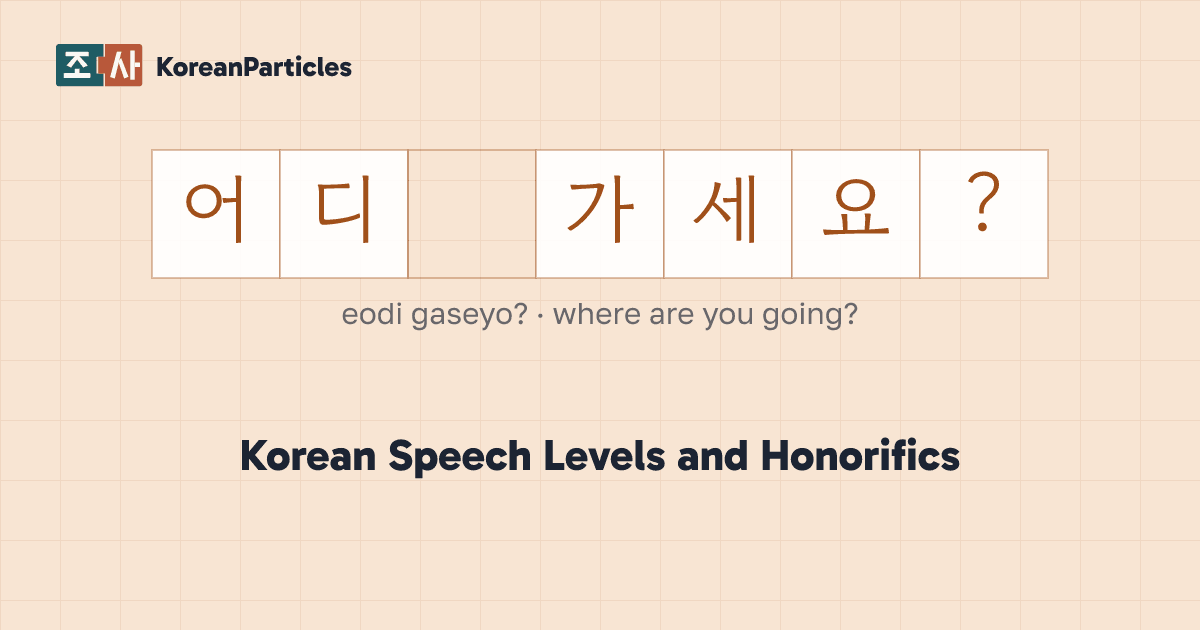
That's also where 세요 (seyo) comes from. 세요 is 시 joined to the polite ending 어요, so 가세요 (gaseyo) is 가 + 시 + 어요. You use it whenever the person doing the action deserves respect, and most often that's the person you're talking to. That's why it's the polite way to ask someone to do something, like 앉으세요 (anjeuseyo, "please sit down"), and the polite way to ask about them, like 어디 가세요? (eodi gaseyo?, "where are you going?"):
After a vowel
→가세요
gaseyo, "please go / are you going?"
After a consonant
→앉으세요
anjeuseyo, "please sit"
Past
→가셨어요
gasyeosseoyo, "(they) went"
Stems that end in ㄹ drop it, so 살다 (salda, "to live") becomes 사세요 (saseyo, "do you live…?"). The one rule to remember is that 시 is never about yourself: you say 제가 갈게요 (jega galgeyo, "I'll go"), never 제가 가실게요. The 세요 lesson and the 시 lesson have more examples of both.
Honorific particles and special verbs
Some words have their own respectful version. The subject particle 이/가 (i/ga) becomes 께서 (kkeseo), and 에게 (ege) or 한테 (hante), "to", becomes 께 (kke). For example, 할머니께서 주무세요 (halmeonikkeseo jumuseyo) means "Grandma is sleeping". 께서 sounds quite formal, though, so in everyday speech many people keep 이/가 and just put 시 on the verb.
A few common verbs also swap for a different word instead of only adding 시:
| Plain | Honorific | Meaning |
|---|---|---|
| 먹다 meokda | 드시다 deusida | to eat |
| 자다 jada | 주무시다 jumusida | to sleep |
| 있다 itda | 계시다 gyesida | to be (somewhere) |
| 주다 juda | 드리다 deurida | to give (to someone you respect) |
드리다 is the odd one out, because it's for when you give something to someone you respect. When they give something, it's 주시다 (jusida). So "did you eat?" to a friend is 밥 먹었어? (bap meogeosseo?), but to your grandmother it's 진지 드셨어요? (jinji deusyeosseoyo?), where 밥 (bap, "meal") also changes to its respectful word, 진지 (jinji). The lessons on 께서 and 에게, 한테 and 께 show how the particles fit with these verbs.
Names: 씨, 님 and 아/야
How you call someone follows the same logic. 씨 (ssi) after a name is polite between equals, like 민수 씨 (minsu ssi), but it isn't for people above you. For a boss or a teacher you use their title with 님 (nim), like 사장님 (sajangnim, "boss") or 선생님 (seonsaengnim, "teacher"). You can put their surname in front, as in 김 선생님 (gim seonsaengnim), but never their name with 씨. And 아/야 is only for friends, younger people and pets.
Which one should you use?
Here's a quick guide for the situations you're most likely to be in:
| Who you're talking to | What to use |
|---|---|
| A stranger, shop staff or a coworker | Polite 요 |
| Your boss, a teacher or someone much older | Polite 요, with 시 when they're doing the action |
| Presentations, job interviews, announcements | Formal 습니다 |
| Close friends, younger siblings, kids | Casual 반말, once you're both comfortable |
If you're ever unsure, use polite 요. It's almost never rude, and nobody expects a learner to get every 시 right, so you can add honorifics bit by bit as you get used to them. Which of these do you find hardest to keep straight? I'd like to know, because it helps me decide which lesson to write next.