
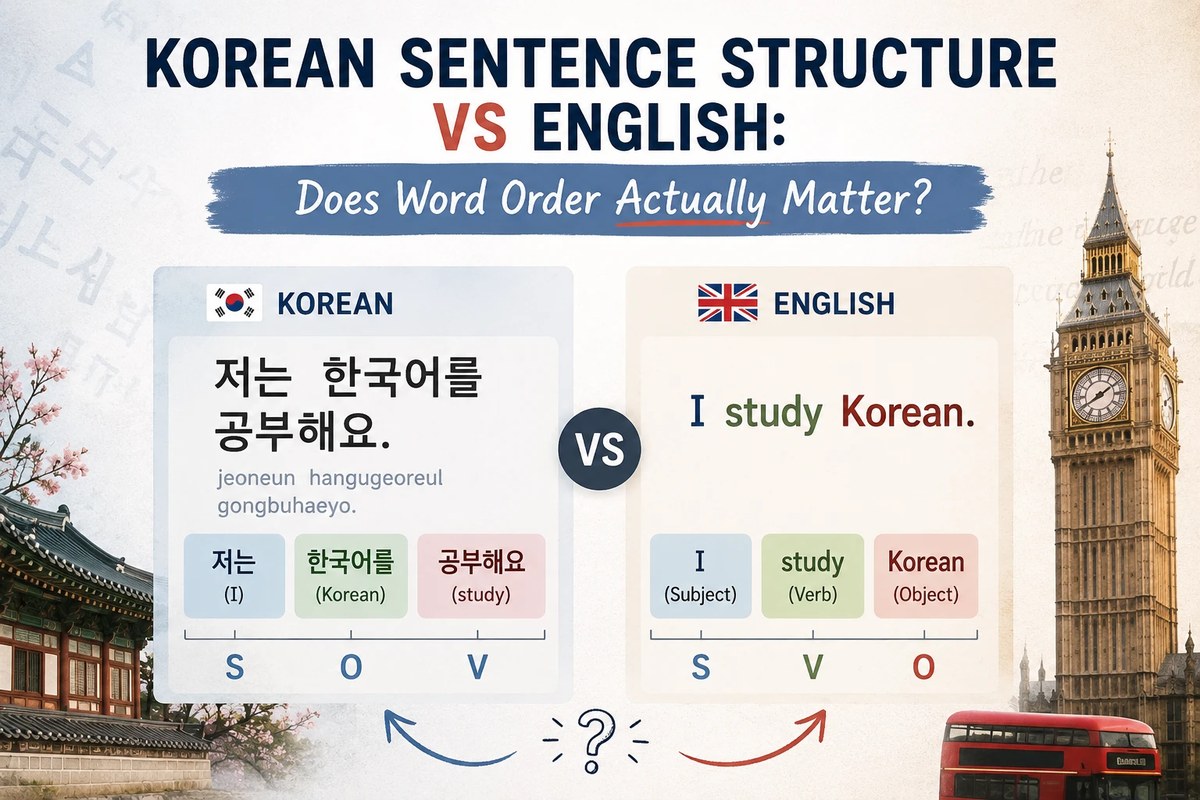
Korean Sentence Structure vs English: Does Word Order Actually Matter?

Francisco Pieklo
Editor
If you’ve read anything about Korean sentence structure for beginners, you already know the first part: Korean basic sentence structure is SOV — subject, object, verb — where English is SVO. So “I eat rice” comes out as “I rice eat.” That’s true, and every guide says it, and it’s about half of what’s actually going on.
The other half took me a long time to notice. In Korean the nouns move and the verb doesn’t. You can shuffle the things at the front of a sentence around and the meaning stays exactly where it was. Try that in English and you either change the sentence or break it. The reason Korean gets away with it is the reason this whole site exists, which is particles.
Does word order matter in Korean?
Less than you’d think.
Here’s a Korean word order example to start with:
- 고양이가 쥐를 봤어요. (goyangi-ga jwi-reul bwasseoyo) — “The cat saw the mouse.”
Now flip the two nouns around:
- 쥐를 고양이가 봤어요. (jwi-reul goyangi-ga bwasseoyo) — “The cat saw the mouse.”
Same meaning. I didn’t change a single word, I just moved them. The second one leans on the mouse a little more, the way you might say “the mouse, the cat saw” in English if you were making a point about the mouse. But nobody’s confused about who did the looking.
In English the same move falls apart. “The cat saw the mouse” and “The mouse saw the cat” are two completely different events, and the only thing that changed was position. English works out who did what from where the words sit. Korean doesn’t have to.
Does Korean have free word order?
Not free, but flexible, with one thing bolted down.
The nouns in front of the verb can move around pretty much however you like. The verb goes last and stays there. So all of these Korean word order sentences are fine:
- 저는 어제 친구를 만났어요. (jeoneun eoje chingu-reul mannasseoyo) — “I met a friend yesterday.”
- 어제 저는 친구를 만났어요. (eoje jeoneun chingu-reul mannasseoyo) — “Yesterday I met a friend.”
- 친구를 저는 어제 만났어요. (chingu-reul jeoneun eoje mannasseoyo) — “A friend, I met yesterday.”
Three orders, one meaning, and 만났어요 (mannasseoyo, “met”) sitting at the end of every one of them. Put the verb anywhere else and the sentence stops working, and that’s not a stylistic preference, it’s the actual limit.
How does Korean word order work, then?
One fixed point, and a lot of free space in front of it.
The verb is the fixed point. Everything else — who did it, what they did it to, when, where — floats around in the space before it in whatever order you feel like. Korean sentence word order is mostly about emphasis, so whatever you put first is what you’re drawing attention to. The hard part was never the order. It’s knowing what marks each piece, and that’s where particles come in.
Korean sentence structure vs English: examples and a chart
Here’s a Korean sentence structure chart with the two languages side by side:
| English | Korean | |
|---|---|---|
| What marks the subject | Position — it goes first | The particle 이/가 (i/ga) |
| What marks the object | Position — after the verb | The particle 을/를 (eul/reul) |
| Where the verb sits | In the middle | At the end, always |
| Can you move the nouns | No, meaning changes | Yes, meaning holds |
| What “to” and “at” look like | Words before the noun | Particles stuck on the back |
That last row is worth a second look. English puts these little words in front, like “to school” or “at home.” Korean sticks them on the back, which is why you’ll sometimes see particles called postpositions:
- 학교에 가요. (hakgyo-e gayo) — “I go to school.” The 에 (e) is glued onto 학교 (hakgyo, “school”).
It’s also why Korean word order in English translation always comes out reshuffled. You can keep the Korean order or you can keep natural English, not both.
Korean sentence structure: particles do the work
This is the bit I wish someone had said to me on day one.
The particle carries the job, so the job travels with the word. 고양이가 (goyangi-ga) isn’t just “cat,” it’s “cat, and this one is the subject,” and that label is attached. You can drop that chunk anywhere in the sentence and it still says the same thing, because it’s carrying its own sign around with it.
English words don’t carry signs. They have to stand in the right spot to be understood, which is why English word order is so rigid and Korean’s isn’t.
Once that clicked for me, a lot of things stopped being weird. Why does the same noun sometimes end in 가 (ga) and sometimes in 를 (reul)? Because I changed its job in the sentence. Why can a Korean sentence start with the object? Because starting there doesn’t make it the subject, since the particle already settled that.
The first pair to get straight is the Korean object vs subject particle question, which is 이/가 against 을/를. The one people really wrestle with after that is 은/는 against 이/가. And if you’re still sorting out Korean particles, when to use each one, start from the list and take them one at a time.
Why the verb won’t move
If particles free up the nouns, why is the verb stuck?
Because in Korean the verb is where the rest of the information lives. Tense, politeness level, whether you’re asking or telling, all of it gets stacked onto the end of that verb. 먹어요 (meogeoyo), 먹었어요 (meogeosseoyo), 먹을까요 (meogeulkkayo) — eat, ate, shall we eat. Same verb, different endings, and those endings are how the sentence actually lands.
Move that to the middle and the listener gets all the details before they know what happened. Korean puts it last on purpose, and it’s why a Korean speaker can flip a whole sentence on the final syllable. You really do have to listen to the end.
Korean sentence structure: adjective placement
Adjectives are the one place where Korean word order feels familiar, and then immediately doesn’t.
Korean word order, adjectives and all, puts them in front of the noun, same as English:
- 예쁜 꽃 (yeppeun kkot) — “a pretty flower”
But when the adjective is the point of the sentence, it moves to the end and behaves like a verb:
- 꽃이 예뻐요. (kkoch-i yeppeoyo) — “The flower is pretty.”
There’s no “is” anywhere in there. 예뻐요 (yeppeoyo) is doing the work of both “is” and “pretty” by itself. Korean adjectives conjugate, which is why you’ll hear them called descriptive verbs, and why they follow the same verb-goes-last rule as everything else.
Korean sentence structure: time, place, then verb
Build a Korean sentence structure with time and place in it and Korean has a preference, which is time first and place second.
- 저는 내일 학교에서 공부해요. (jeoneun naeil hakgyo-eseo gongbuhaeyo) — “I’m studying at school tomorrow.”
내일 (naeil, “tomorrow”) comes before 학교에서 (hakgyo-eseo, “at school”). English does the opposite and shoves the time to the end.
Swapping them in Korean won’t make you wrong exactly, it’ll just make you sound a bit off. And Korean sentence structure, location included, leans on two particles that both get translated “at,” so it’s worth knowing when to use 에 and when to use 에서.
Korean particle order when they stack
This comes up the moment you start moving pieces around: sometimes two particles land on the same noun, and they have an order.
The position particle goes first, then the topic or focus particle sits on top of it:
- 학교에서는 (hakgyo-eseo-neun) — “at school, as for...” — 에서 (eseo, “at”) then 는 (neun)
- 친구에게도 (chingu-ege-do) — “to my friend, too” — 에게 (ege, “to”) then 도 (do)
But 이/가 and 을/를 don’t stack like that. They get replaced instead:
- 책을 (chaeg-eul, “book” as object) + 도 (do, “too”) → 책도 (chaek-do), never ×책을도
That last one is the most common particle mistake I run into. When you add 도 (do, “too”) or 만 (man, “only”) onto a subject or an object, the old particle steps aside instead of doubling up.
Korean sentence structure practice
Read these Korean sentence structure examples and work out who did what before you look at the verb:
1. 민수가 케이크를 먹었어요. (Minsu-ga keikeu-reul meogeosseoyo) 2. 케이크를 민수가 먹었어요. (Keikeu-reul Minsu-ga meogeosseoyo) 3. 케이크가 민수를 먹었어요. (Keikeu-ga Minsu-reul meogeosseoyo)
One and two say the same thing, which is that Minsu ate the cake. Number three is a cake eating Minsu, and the only thing that changed was which particle went where. The words are sitting in a perfectly normal order in all three.
If you want more reps, the closest thing to a Korean sentence structure quiz on the site is the quiz on each particle page. Get the particles automatic and the order takes care of itself.
Common questions
What is Korean word order? Subject, object, verb. The subject and object can trade places, but the verb can’t leave the end.
Is Korean SOV or SVO? Korean sentence structure: SOV, though it’s better treated as a default than as a fixed template.
Why is Korean SOV, and does Korean use SOV all the time? It’s just the shape the language settled into, and yes, the verb-final part holds everywhere: casual speech, writing, questions, all of it. The only flexible bit is what happens in front of the verb.
What is the Korean sentence order, compared to English? Korean sentence order vs English comes down to this: Korean is subject, object, verb, and English is subject, verb, object. That’s the surface difference.
How does Korean sentence structure differ from English? Underneath the word order, English assigns roles by position and Korean assigns them with particles. Nearly everything else follows from that one difference.
Is Korean sentence structure similar to English? Not really, for the reason just above. Korean simple sentence structure looks tidy enough on paper, but it runs on a completely different principle.
Is Korean sentence structure similar to Japanese? Much closer, yes. Korean sentence structure vs Japanese is a short conversation: both are SOV, both put the verb last, both use particles. The particles themselves aren’t the same, though, so don’t map them one to one.
Where do adjectives go in Korean sentence structure, adjective placement aside? In front of the noun when they’re modifying it, and at the end when they’re the point of the sentence.
Do Koreans really move words around, or is that just textbook stuff? They do it constantly, especially when speaking. They also drop particles entirely when the context makes everything obvious.
What happens if I put the verb in the middle? The sentence stops working. Out of everything here, that’s the one rule with no give in it.
I spent a long time treating Korean sentence structure as a shape to pour words into, and it kept letting me down every time I heard a real sentence that didn’t fit the shape. Learning what each particle does fixed that, because the order is only loose in the first place thanks to how precise the particles are.
So which order still trips you up, or is it a particle pair? Pick one and work through it.